You solved the quadratic correctly on paper. MyMathLab still marked it wrong because you typed "x=2,3" instead of using the math palette. That sting is more common than most professors admit. Student forums on Reddit and Quora are full of the same complaint: the auto-grader reads exactly what you typed, not what you meant, and a single syntax error can zero out an otherwise correct solution. George Mason University's Fall 2023 modality report found students in online sections were at least 1.47 times more likely to earn a D, F, or withdrawal than face-to-face peers across half of all undergraduate courses. Between 2020 and 2025, UC San Diego reported math preparation below high school level among entering first-year students increased nearly thirtyfold, per the Senate-Administration Working Group report (.edu). If you are taking college algebra or finite math on MyMathLab, ALEKS, or WebAssign while working 25 or more hours a week, you are not behind because you are lazy. You are in a course format that punishes formatting mistakes and rewards students who can protect real study blocks. I have proctored thousands of hours in these platforms, and the pattern is consistent. This guide covers the hour audit and platform traps that generic "study harder" posts skip.
Can You Pass College Math Online While Working Full-Time?
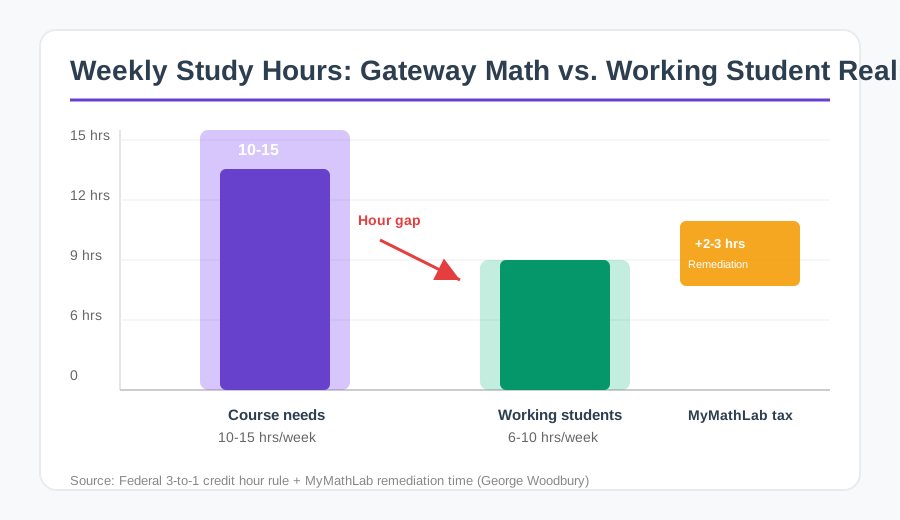
Yes, you can pass college math online while working full-time if you protect 10 to 15 weekly hours for one three-credit gateway course. That is the direct answer most search results bury under vague scheduling advice. Without those hours, the honest answer shifts to "probably not without dropping something else," and that is not failure. That is math.
Start with a real hour audit. List work shifts, commute, sleep, meals, and family obligations first. Whatever remains is your study ceiling. A 2019 Walden University dissertation studying online gateway math at a large Florida community college found success rates ran more than 10 percentage points lower in online sections than face-to-face sections, even after controlling for demographics. You are not imagining the extra friction.
Passing does not always mean an A. For some students, passing means a C in college algebra so nursing or business prerequisites stay on track. For others, it means protecting a 3.2 GPA for transfer applications. Decide which version of "pass" you need before you register for two math-heavy courses in the same term while picking up overtime.
George Mason's Office of Institutional Effectiveness and Planning (.edu) documented a median odds ratio of 1.47:1 for online DFW risk. That does not mean online math is impossible. It means you need a plan, not optimism. Students on Reddit and Quora forums consistently report losing points on correct work because Pearson's auto-grader reads exactly what you typed, not what you meant. Hard work that does not show up in the gradebook pushes people toward shortcuts they regret at exam time.
Frankly, if you work 40 hours and you are taking college algebra plus statistics in the same eight-week term, the schedule math usually fails unless you have serious backup at home. One gateway math course per term is not giving up. For many working adults, it is the fastest route to a degree because you finish instead of withdrawing after week six.
George Woodbury, a community college math instructor who has written extensively on MyMathLab, warns students not to procrastinate on adaptive homework because remediation takes time the platform will not forgive. I have seen this play out hundreds of times in proctored lab hours. The students who pass are rarely the smartest. They are the ones who treated study blocks as non-negotiable before the first exam week hit.
How Many Hours a Week Should You Study for College Math Online?
Plan on 10 to 12 hours per week for a single three-credit online college math course, plus a 2 to 3 hour buffer during MyMathLab remediation weeks. That range beats the vague "study two hours a day" advice floating around student forums because it maps to how gateway math platforms actually consume time.
The 3-to-1 Rule (and the MyMathLab Remediation Tax)
The federal credit hour definition in 34 CFR Section 600.2 expects at least one hour of instruction plus two hours of out-of-class work per credit hour weekly. For a three-credit course, that lands near 9 hours minimum. Math courses on adaptive platforms routinely exceed that baseline because wrong-format retries, pie-chart remediation, and paper-to-keyboard translation eat clock time the syllabus never mentions.
George Woodbury tells students that MyMathLab helps diagnose difficulty and remediate, but the process takes time and works best when you start assignments early. Germanna Community College's MyMathLab tips PDF (.edu) adds a practical rule: use the math palette for every symbol. Keyboard entry triggers syntax errors the auto-grader will not forgive. Each rejected attempt is another 10 to 15 minutes you did not budget.
Here is how the hours break down for a typical working student in one gateway math course:
| Activity | Hours/Week | Notes |
|---|---|---|
| Lecture videos and readings | 2 to 3 | Passive review; not a substitute for problem reps |
| Homework problem sets (paper first) | 4 to 5 | Lamar University's study math guide (.edu) stresses active involvement |
| Platform entry and format retries | 2 to 3 | MyMathLab "similar question" loops add up fast |
| Quiz or exam prep | 2 to 3 | Front-load before due dates, not the night before |
| Total (one 3-credit course) | 10 to 14 | Add 2 to 3 hrs during heavy remediation weeks |
If you work 30 or more hours weekly, default to one gateway math course per term. UNC Charlotte reported college algebra DFW rates near 20% and introductory statistics near 22% from 2015 to 2018 before course redesign, per EDUCAUSE Review. Those are baseline failure rates for students with fewer job constraints than you have.
Block out your week on paper before you trust your memory. Subtract sleep, work, and commute first. What is left is your real study budget, not the number on the syllabus. CSU Global recommends scheduling study sessions at consistent times rather than cramming, and that advice matters twice as much when your employer already owns your mornings.
Run the numbers and you are still short on hours? Some working students explore online math class help when retaking a gateway course would cost more than getting structured support once. That is a math problem too, and it deserves an honest answer before week four, not after the withdrawal deadline passes.
Is Online College Math Harder Than In-Person?
Online college math is not the easy option. Many students register for online algebra or statistics thinking they can fit the coursework into their weekends, only to find the class requires more work than the face-to-face version. The material is the same, but you lose the guardrails of a physical classroom. You trade weekly lectures for self-paced modules, and that flexibility becomes a trap if your schedule is already packed.
The numbers back this up. A 2019 dissertation study from Walden University analyzed gateway math performance at a large Florida community college and found that success rates in online sections were more than 10 percentage points lower than in face-to-face sections. That success gap persists across different student groups. When George Mason University's Office of Institutional Effectiveness and Planning published its Fall 2023 undergraduate course report, online sections across the university showed a median DFW (D grades, F grades, and withdrawals) odds ratio of 1.47 compared to in-person classes. This means online students were 47% more likely to fail or withdraw from the same courses.
In-person classes force you to sit in a room for three hours a week and watch a teacher solve problems on a board. If you do not understand a step, you can raise your hand. Online, you are on your own. You must read the digital textbook, watch pre-recorded videos, and interpret platform error messages yourself. The flexibility of online learning is great for scheduling, but it does not reduce the workload. In fact, it increases the self-discipline required to pass.
Consider the baseline failure rates. At the University of North Carolina at Charlotte, pre-redesign data published in 2023 by EDUCAUSE Review (.edu) showed that College Algebra DFW rates sat near 20%, while Introductory Statistics sat at 22%. Those statistics represent classroom students. When you move those courses online without adding structured study blocks, the DFW rates climb. Passing requires recognizing that online math is different, not easier.
MyMathLab, WebAssign, and ALEKS: Platform Playbooks That Save Your Grade
Your online math class is not run by your professor. It is run by a software platform. Whether your school uses Pearson MyMathLab, Cengage WebAssign, or McGraw-Hill ALEKS, the software dictates how you learn, how you submit homework, and how you are graded. Treating these platforms like regular homework sites is a recipe for frustration. You need to understand the rules of the specific software you are using to avoid dropping points on correct math.
| Platform | Grading Style | Pacing System | Main Trap |
|---|---|---|---|
| Pearson MyMathLab | Exact Match (allows 3 attempts) | Weekly Assignments | Formatting and syntax errors |
| Cengage WebAssign | Tolerance Range (set by teacher) | Standard Due Dates | Keyboard shortcut errors |
| McGraw-Hill ALEKS | Adaptive Mastery (no attempts count) | Pie Chart Progress | Pacing decay and knowledge checks |
Pearson MyMathLab and MyLab Math
Why does MyMathLab mark my answer wrong when my math is right? In most cases, it is a syntax or formatting issue, not a math error. If the problem asks for an integer and you write a fraction, or if you type a lowercase x when the system expects an uppercase X, you get a red X. Student forums are full of screenshots showing correct decimals rejected because the system wanted a simplified fraction.
To survive MyMathLab, you must use the built-in math palette for every fraction, square root, or exponent. Germanna Community College's MyMathLab Plus tips sheet (.edu) notes that using keyboard shortcuts instead of the formula editor is the leading cause of input errors. Math educator George Woodbury advises using the "Ask My Instructor" button when you are stuck. This sends a direct link to your specific problem (and your exact numbers) to the professor, showing them what you entered. It is the fastest way to get credit for a formatting error.
Cengage WebAssign
WebAssign is common in calculus and statistics. It uses the MathPad palette for entering symbols. Unlike MyMathLab, which often has a rigid exact-match grading system, WebAssign uses numerical tolerance. If the correct answer is 3.14 and the tolerance is set to 2%, the system accepts answers between 3.08 and 3.20. But this tolerance only works if your syntax is perfect.
Watch the palette preview. WebAssign has an eye icon that shows how the system interprets what you typed before you submit. If you type a fraction and the denominator remains outside the box, the preview shows the error. San Jose State University's math department recommends using calculator notation rather than guessing keyboard shortcuts when entering complex equations in WebAssign. If you use WebAssign, click that preview button before you burn one of your five submissions.
McGraw-Hill ALEKS
How do you pass ALEKS college algebra? You pass by managing the adaptive pie chart and starting early. ALEKS does not use weekly homework sets. Instead, it uses an artificial intelligence engine to assess your knowledge state and give you topics you are ready to learn. If you answer three questions correctly in a row, you master the topic. If you get a question wrong, the system adds more practice questions to your queue.
This adaptive setup means you cannot cram. Santa Barbara City College published data on its ALEKS Pathways through Algebra project showing that students who completed 75% or more of their ALEKS pie had success rates near 80%, while those who finished zero topics had a success rate of 22.8%. Similarly, Arizona State University reported College Algebra pass rates rose from 60% to 79% after redesigning the course around ALEKS. To pass, you must hit your weekly topic goals. If you skip a week, the next Knowledge Check will drop your pie completion percentage and force you to relearn old material.
The Weekly Study Map: What Actually Eats Your Hours in Gateway Math
Most college courses are writing-heavy or reading-heavy. Online math is different: it is process-heavy. You do not write essays, but you spend hours solving problems, correcting mistakes, and retrying calculations. To manage your time, you need to understand where those hours go. If you do not track your hours, you will find yourself staring at an unfinished homework set at 11:00 p.m. on Sunday night.
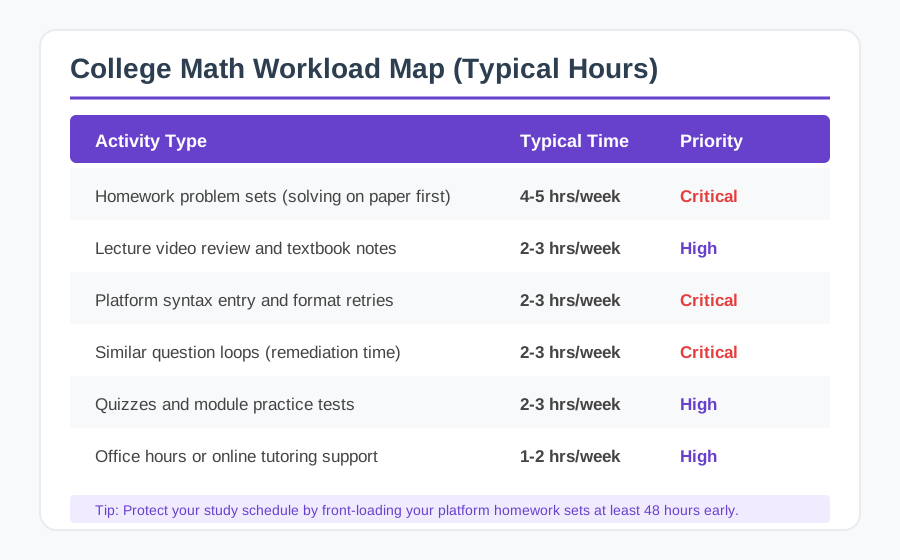
A typical week in college algebra or precalculus consists of two homework modules and a quiz. The syllabus might list these as three simple tasks, but each task has hidden steps. The problem sets require solving equations on paper, checking your arithmetic, typing the solutions into the software, and dealing with formatting rejections. If the software uses adaptive learning, getting a question wrong adds three new questions to your homework queue. This adaptive feature is designed to help you learn, but it makes time management unpredictable.
George Woodbury warns students that procrastinating on adaptive homework is dangerous because you cannot estimate how long an assignment will take. If you understand the material, a module might take two hours. If you struggle with a concept, the platform's remediation loops can stretch that same module to five hours. That is why you must start assignments early. Front-loading your week by completing lecture notes and the first half of the homework by Wednesday protects you from the weekend remediation pile-up.
When work shifts run long or family emergencies happen, you need a backup plan. In my math tutoring sessions, I advise students to use a minimum viable week strategy. If you cannot complete every reading, focus on the graded homework sets first. Let the optional practice problems go, submit what you can, and protect your grade from a zero. A grade of 75% on a rushed assignment keeps you in the course; a zero puts you in the DFW zone.
How to Study College Math Online (Methods That Beat Passive Review)
What is the best way to study for an online math class? The answer is active recall on paper, not watching videos on a screen. Many online students fall into the passive review trap: they watch their instructor solve a problem in a video, feel like they understand it, and then fail the quiz. Watching someone else solve an equation is a passive activity. Doing it yourself is active learning.
Lamar University's online math study guide stresses that you cannot learn math by simply reading or watching. You must be actively involved in the process. When you watch a lecture video, keep a notebook open. Copy down the sample problems and solve them along with the instructor. Once the video ends, close your notes and try to solve the same problem again. This simple check is the first step of active recall.
A meta-analysis by SRI International on online learning and mastery course designs found that active learning systems improved student outcomes with an average effect size of 0.47, though the demand on student time was significantly higher. To make the most of your study hours, use interleaved practice. Instead of practicing ten problems of the same type in a row, mix them up. Solve a linear equation, then a quadratic, then a graphing problem. Interleaving forces your brain to identify which method to use, which is exactly what you must do on an exam.
Cognitive science research on spaced repetition shows that students forget up to 73% of new formulas within 48 hours if they do not practice them. To combat this decay, maintain a physical mistake log. Divide your log into two columns: format errors and concept errors. Format errors mean you knew the math but typed it wrong. Concept errors mean you did not know the steps. Reviewing this log before you open a quiz prevents you from repeating the same mistakes.
If you are rusty on basic algebra, use Khan Academy for gap-fill practice. Do not try to relearn algebra while completing college-level algebra homework. Spend 20 minutes on basic factoring or fraction operations first, then open your college platform. Separating prerequisite review from your graded homework keeps your study sessions productive and prevents frustration.
Common Mistakes That Fail Online College Math Students
After observing students navigate online math platforms for years, I have noticed that failure rarely comes from a lack of intelligence. Most students who fail do so because of bad study habits or technical errors. Math is a cumulative subject, meaning that what you learn in week two is required to understand week three. If you make a mistake early in the term, it will follow you to the final exam.
The first major mistake is guessing homework questions. Many platforms allow you to try a similar question after a wrong answer. Some students click through these attempts, changing their numbers slightly until they get a green checkmark, without actually understanding why the answer changed. Math instructor George Woodbury warns that this pattern-guessing creates a false sense of security. You might get 100% on the homework, but you will fail the proctored exam when there are no hints or retries available.
Another common mistake is ignoring technical requirements. Online platforms require specific browser settings, popup blockers turned off, and proper zoom levels. Students frequently report that they could not see the math symbols on a timed test because their browser zoom was set too high, or that their quiz locked up because they opened a new browser tab. These are technical failures that could have been avoided with a simple setup check.
Finally, many students fail because they do not review prerequisites. If you are taking college algebra but struggle with basic fraction addition, you will spend twice as long on every homework set. Do not ignore your weak areas. Address them early in the term, ask for help when you need it, and treat the platform rules as part of the curriculum, not just a nuisance.
Your First Two Weeks: A Pass-College-Math-Online Checklist
The first two weeks of an online math course determine your final grade. If you fall behind in algebra or statistics by week three, the cumulative nature of the material makes catching up extremely difficult. You spend your time trying to learn new concepts using foundational skills you never mastered. Start with a structured checklist to audit your schedule and configure your system before the first high-stakes assignment is due.
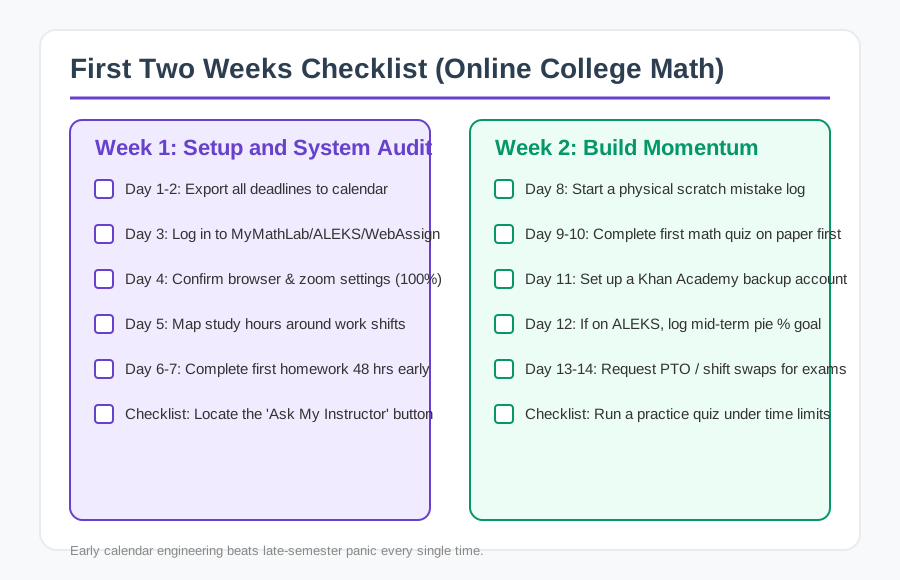
George Woodbury advises students to log in and start early because adaptive learning systems require remediation cycles that consume hours you might not budget. The 2006 Pathways through Algebra report from Santa Barbara City College highlighted that students who completed 75% or more of their adaptive learning topics had success rates near 80%, while those who finished none succeeded at a rate of only 22.8%. Early momentum is not about academic skill. It is about setting up your study environment before deadlines pile up.
Your setup matters. Clear your browser cache and set your browser zoom to 100% before starting any work. The math symbols in MyMathLab and WebAssign can render incorrectly if your screen resolution is zoomed in or out. Germanna Community College's MyMathLab Plus tips sheet notes that using the math palette for every symbol, rather than keyboard shortcuts, prevents common syntax errors. Taking these mechanical steps during week one saves you from losing points on correct calculations later.
Protecting Exam Weeks When You Work Full-Time
Managing online math exams while working 40 hours a week requires schedule planning, not just late-night cramming. Timed tests do not care about your work shifts. If you sit down for a midterm after a 12-hour shift on your feet, your brain is already tired. You will make simple arithmetic mistakes or misread the platform formatting prompts. You need to adjust your work commitments during exam weeks.
Talk to your employer early in the semester. Let them know your exam dates and ask to swap shifts or use a day of paid time off (PTO). CSU Global's online math guide recommends taking practice tests under timed conditions to simulate the proctored environment. This practice helps you build speed and reduces the anxiety of watching the exam clock count down. Protecting your exam day ensures you perform at your best.
Proctored exams often use software like Honorlock or ProctorU. These systems monitor your webcam, screen, and microphone. A 2023 study on online proctoring systems showed that technical setup issues, like poor lighting or outdated browser extensions, consume an average of 14 minutes of student time before an exam begins. Avoid this stress by running the system checks 24 hours before your test starts. Eliminating technical hurdles lets you focus entirely on the math questions.
When to Get Help With Your Online Math Class
You need to know your limits. Every student wants to pass on their own, but struggling in silence for six weeks usually leads to a withdrawal or an F. If you wait until week ten to seek help, your professor cannot do anything to salvage your grade. Establish a strict trigger list for when you must seek outside support. This proactive approach keeps you in control of your academic record.
A meta-analysis by SRI International on online learning and mastery course designs found that active learning systems improved student outcomes with an average effect size of 0.47, though the demand on student time was significantly higher. In practical terms, this means that if you run out of study hours, the system's adaptive loops will lock you out of progress. If you miss two consecutive homework deadlines or earn less than 70% on your first midterm, you have reached a critical point. Do not wait for the next exam to see if things improve.
Gateway math courses have high failure rates. UNC Charlotte's course redesign data showed baseline DFW rates of 20% for college algebra and 22% for introductory statistics. If your workload makes it impossible to protect 12 study hours every week, seek professional assistance early. Exploring options like online math class help can keep you from wasting tuition dollars on a retake. Make a strategic decision before your GPA suffers permanent damage.
Passing Your Online College Math Class Is a Scheduling Problem First
You started this article wondering how to pass college math online while managing a full-time job. You now have the exact numbers, the platform playbooks, and the study strategies to protect your schedule and your GPA. Passing is not about luck. It is about calendar engineering and understanding the software platform your syllabus uses. Focus on consistent progress rather than cramming.
Here are your key takeaways to keep your course on track:
- Protect 10 to 15 weekly hours for a single three-credit course to account for platform formatting and remediation cycles.
- Use the built-in math palette on MyMathLab or WebAssign instead of keyboard shortcuts to avoid auto-grader rejections.
- Homework sets should be started 48 hours early to ensure you have time to resolve formatting errors or ask your instructor questions.
- Keep a written mistake log to separate syntax errors from conceptual gaps before you open a timed quiz.
- Establish clear triggers for outside help to ensure you take action before the withdrawal deadline passes.
Your immediate next step is simple. Tonight, log in to your course portal, audit your calendar for the next two weeks, and write down every math deadline on a physical sticky note. If you run the numbers and realize your schedule is too tight to manage the workload, explore your support options. Professional online math class help can keep your degree path on track, ensuring you fulfill your quantitative requirements without risking a second failed attempt. The U.S. Bureau of Labor Statistics reports the median wage for math-heavy occupations is $104,620, making these courses a barrier worth overcoming.
Struggling With Your Online Math Class?
Our U.S.-based math specialists complete homework, quizzes, and proctored exams on MyMathLab, ALEKS, and WebAssign. Get your coursework done without failing.
You started this article wondering how to pass college math online while working full-time. You can, with the right study budget, software strategies, and a structured checklist. If the numbers still do not work for your schedule, talk to our team about online math class help before your GPA drops.
Frequently Asked Questions
1. Can you pass college math online while working full-time?
Yes, you can pass college math online while managing a full-time job if you protect 10 to 15 study hours per week. Successful working students block their study time in advance and treat these study blocks as non-negotiable commitments. One three-credit online college math course requires 10 to 12 hours of weekly effort. If you work 40 hours a week, you must plan your schedule carefully.
2. How many hours a week should I study for college math online?
Plan on 10 to 12 hours per week for a single three-credit college math course. If you are taking a compressed eight-week summer session, this requirement doubles to 20 or 24 hours per week. The standard academic expectation is three hours of independent study for every one credit hour of class. Because math is process-based, you must budget hours for active homework practice.
3. Is online college math harder than in-person class?
Online college math is often harder due to the lack of live lectures and the strict grading systems used by online math platforms. In a classroom, an instructor can give you partial credit for showing your work. Online software like MyMathLab or WebAssign is binary: your answer is either correct or incorrect. A small formatting error can cause you to lose points on a correct calculation.
4. What is the best way to study college math online?
The best way to study is active recall on paper. Do not just watch instructional videos or click through homework examples. Write out every step of a problem on physical paper before entering your answer into the platform. When you make a mistake, find the exact step where your calculation went wrong. Keep a dedicated notebook for platform homework to review before proctored exams.
5. Can I pay someone to take my online math class for me?
Yes, you can hire an expert math class help service to complete your online math course, homework, quizzes, and proctored exams. Our specialists assist students who are overwhelmed by work shifts or family duties. We handle assignments on platforms like Pearson MyLab, ALEKS, and Cengage WebAssign, ensuring you earn passing grades without sacrificing your job.
6. How does hiring someone for an online math class work?
You share your course syllabus and login information with us, and we match you with a math specialist who completes your weekly assignments. All communication and account access is encrypted. The specialist handles homework modules, discussion posts, quizzes, and proctored midterm or final exams, keeping you updated on grades throughout the semester.
7. Is my login information secure when hiring math help?
Yes. We use advanced proxy setups to ensure all login attempts originate from your home state or city. This prevents colleges from flagging your account for suspicious login locations or IP changes. We protect your personal information and never share your data with school administrators or third parties.