You clock out after a 12-hour shift, eat something that barely counts as dinner, and open Canvas on your phone. Two discussion posts, a care plan draft, and a pharmacology quiz all due before Sunday night. A 2023 systematic review of 7,326 undergraduate nursing students across 10 countries found 46% showing measurable burnout. If that sounds like your Tuesday, this guide is for you. Not generic college study tips. A pass plan built for nurses who cannot quit their paycheck to finish one more class.
Can You Pass an Online Nursing Class While Working Full-Time?
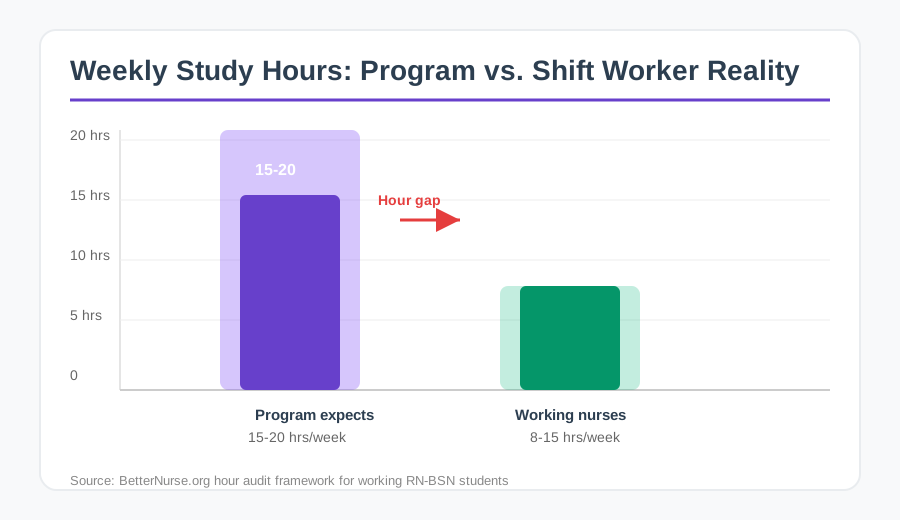
Yes, you can pass an online nursing class while working full-time if your protected study hours match what the course actually demands. Most working nurses realistically protect 8 to 15 hours per week for coursework after shifts, sleep, commuting, and family obligations are accounted for, while full course loads often expect 15 to 20 hours weekly according to BetterNurse.org. That gap is where good nurses fail classes they absolutely could have passed with a slower plan.
Passing does not always mean an A. For some RNs, passing means a C in Pathophysiology so they keep their hospital job and stay in the RN-to-BSN track. For others, it means protecting a 3.5 GPA for CRNA or NP applications. Be honest about which version of "pass" you need before you map your semester.
A 2019 study of online RN-to-BSN students at a California state university found 62% worked full-time, averaging 31 to 40 or more hours per week. Attrition ran higher than on-campus cohorts until the program added orientation and peer support. You are not an edge case. You are the default student in most online nursing completion tracks.
Frankly, most blog posts stop at "stay organized" and never answer the question you typed into Google at 11 p.m. So here is the direct answer: if you work 36+ hours on the floor and you are taking two writing-heavy nursing courses in the same 8-week term, the math usually does not work unless you have serious backup at home. One course per term is not giving up. For many working nurses, it is the fastest route to a degree because you actually finish instead of withdrawing.
Why Online Nursing Classes Became the Default for Working RNs
Online nursing coursework for working adults did not appear overnight. The University of Illinois Chicago launched its RN-to-BSN completion track on a Quad Cities campus in 1980 with a handful of students. By 2008 the program moved fully online. UIC Nursing reported growth from about 200 students in 2020 to roughly 490 by fall 2024, and U.S. News ranked it among the top online RN-to-BSN programs nationally that same year, according to UIC College of Nursing.
The national picture shifted fast after the Institute of Medicine's 2010 Future of Nursing report pushed for 80% of nurses to hold a BSN by 2020. Hospitals chasing Magnet status started requiring degrees. RN-to-BSN enrollment climbed for years, then hit headwinds. The American Association of Colleges of Nursing reported RN-to-BSN enrollment fell 16.9% between 2021 and 2022, dropping below 100,000 students nationwide for the first time since 2012, per a CUNY nursing workforce report citing AACN data. Enrollment dipped, but the programs did not disappear. AACN still lists more than 700 RN-to-BSN programs, most online or hybrid.
What That History Means for You on Night Shift
Here is what changed for the nurse reading this on a break room couch: schools built asynchronous Canvas courses so you could post discussions at 2 a.m. after a med-surg shift. That flexibility is real. But the workload did not shrink. Online nursing classes swapped lecture halls for weekly APA papers, peer replies, virtual simulations, and care plans graded against NANDA-I diagnosis standards. Different format. Same rigor. Often more writing.
New America noted in 2024 that over 80% of RN-to-BSN programs are at least partially online, with compressed terms and open start dates designed specifically so working nurses do not have to pause employment. The University of Virginia School of Nursing reported in 2024 that while national RN-to-BSN enrollment declined, part-time hybrid programs built for bedside nurses continued growing at some institutions. The market is splitting: nurses who need slow, survivable pacing versus nurses who can sprint.
Wendi Myers, MSN-Ed., RN, vocational nurse program director at Galen College of Nursing, told students plainly: "Your time management has to be on point... you're not going to be able to do everything you did before." That quote is ten years old and still the truest thing anyone has said about nursing school while employed.
And the stakes are not just personal pride. The National Council of State Boards of Nursing's 2023-2024 education database found 51.4% of nursing programs reporting on-time graduation rates below 70%. Falling behind one online class often signals burnout, not laziness. NCSBN itself notes that students plan lives around graduating on schedule, and missing that window links to attrition.
How Many Hours a Week Should You Study for One Online Nursing Class?
Plan on 7 to 12 hours per week for a single three-credit online nursing course if you are working full-time. Point Loma Nazarene University's RN-to-BSN FAQ tells students to budget 7 to 9 hours weekly for a three-semester-hour class, not counting major papers. The University of Olivet (.edu) applies the federal 3-to-1 rule: three hours of out-of-class work per credit hour, so one three-credit course lands near 9 hours minimum. Floor nurses should add 2 to 3 hours of buffer for APA formatting, rubric re-reads, and the second discussion reply you keep putting off until Sunday.
The 3-to-1 Credit Hour Rule (and Why It Breaks for Floor Nurses)
The textbook ratio assumes you have a quiet desk and a predictable afternoon. You have a break room, a pager, and a schedule that flips every month. That is why BetterNurse.org's 2025 guide separates program expectations (15 to 20 hours at full load) from what working nurses actually protect (8 to 15 hours). The gap is not laziness. It is shift math.
| Course Load | Weekly Study Hours | Best For |
|---|---|---|
| 1 online nursing class | 8 to 12 hours | Full-time floor nurses (36 to 40+ hrs/week) |
| 2 online nursing classes | 15 to 25 hours | Predictable schedules, strong writing speed |
| 3 online nursing classes | 30+ hours | Rarely sustainable with full-time work |
Run your own audit before the add/drop deadline. Write down shifts, sleep, commute, kids, meal prep, and laundry. What is left? If the answer is 9 hours and your two classes need 22, you already know the outcome. I've watched nurses try to brute-force that gap with energy drinks. They usually withdraw by week six.
How Many Online Nursing Classes Should You Take Per Term?
If you work 36 to 40 hours on the floor, default to one online nursing class per term. That is not conservative advice. It is the load that matches the 8 to 12 hour weekly window most working nurses can actually defend. NCSBN's 2023-2024 National Nursing Education Database found 51.4% of programs reporting on-time graduation rates below 70%. Slowing down beats becoming a withdrawal statistic.
Two classes per term can work. But only if your schedule is predictable, you have prior online success, and you write APA papers without staring at a blank screen for an hour. An RN on allnurses.com described SNHU's 8-week RN-to-BSN track: discussions every week, milestone papers building toward an 8 to 12 page final. That is two classes worth of writing hiding inside one course label sometimes.
| Your Work Situation | Recommended Load | When to Reconsider |
|---|---|---|
| 36 to 40+ hrs/week, rotating shifts | 1 class | Add 2nd only after one A/B term |
| 24 to 32 hrs/week, stable schedule | 1 to 2 classes | Skip 2 if term includes research/stats |
| Returning after 5+ year break | 1 class | Rebuild writing stamina first |
Frankly, the nurses I see finish RN-to-BSN programs while employed are almost always part-time students who stopped apologizing for it. One allnurses poster said a part-time semester "is MUCH less stressful on work life, home life, and any other aspect of personal life." That matches what BMC Nursing reported in 2021: delayed completion in online RN-BSN programs usually traces to overlapping work and course demands, not low intelligence.
Is Online Nursing School Harder Than In-Person?
Online nursing school is not easier. It is differently hard. You trade lecture halls for weekly discussion boards, APA papers, and self-directed modules on Canvas. The American Association of Colleges of Nursing notes that online RN-to-BSN students often juggle 24/7 work schedules and family duties, and the asynchronous format can feel isolating when deadlines stack up without a professor in front of you.
Here's what the brochure won't say: online nursing classes often require more writing than campus versions of the same course. A 2021 BMC Nursing study on delayed online RN-BSN completion found students, faculty, and institutions all play roles in on-time graduation. Students cited workload overlap and weak time boundaries. That is the online penalty, not the content itself.
Online wins on flexibility, not workload reduction. You can post at 2 a.m. after night shift. But you still have to post. And reply. Twice. On two different days, on most syllabi.
The Nursing Workload Map: What Actually Eats Your Week
Most guides say "stay on top of assignments." Here is what that means in a Canvas shell when you are a med-surg nurse with three days on and four days off.
Discussion Boards and Peer Replies
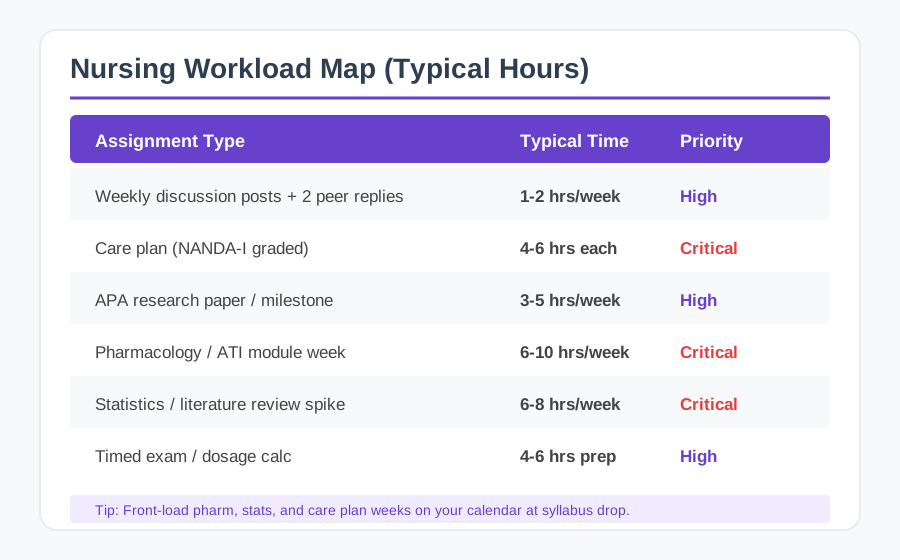
Most online nursing courses require an initial post supported by evidence plus two peer replies on separate days. Budget 1 to 2 hours per week per course. BetterNurse.org calls discussion posts the assignment that most often delays working nurses because they are frequent and need real engagement, not copy-paste sympathy.
Batch a template: claim, citation, clinical example, question back to the cohort. Post by Tuesday or Wednesday even if it is rough. Revision beats creation at midnight. If you are underwater, discussion post help beats a zero for non-submission.
Care Plans and Clinical Write-Ups
Care plans graded against NANDA-I diagnoses eat 4 to 6 hours each for newer students. Your first one takes longer than your fifth. An SNHU student on allnurses described milestone papers building toward an 8 to 12 page final over an 8-week term. That is not one assignment. It is a slow-motion paper with weekly checkpoints you cannot skip.
Pharmacology, ATI, and Exam Weeks
Pharmacology modules and ATI-style quizzes spike time demand to 6 to 10 hours in a single week. Nursing research courses do the same during statistics and literature review units, per guides from nursing education publishers. Front-load those weeks in your calendar the day the syllabus drops. This is the part most generic study blogs skip.
How to Build a Shift-Aware Study Schedule (12-Hour Workers)
Fixed daily study times fail for rotating nurses. Plan week by week around your actual shifts, not an ideal calendar. BetterNurse.org found the nurses who finish treat coursework like a second job with movable shifts, not leftover minutes.
Sample Week: 3-On, 4-Off Schedule
- Work days 1 to 3: 15 to 20 minutes of flashcards or 5 practice questions on break. No new content after a 12-hour shift.
- First day off: Your primary study day. Block 3 to 4 hours for papers or care plans after one recovery sleep.
- Second day off: Deep work: 2 to 3 hours on highest-weight assignment.
- Third day off: Light review, discussion replies, prep for next stretch.
Wendi Myers, MSN-Ed., RN, at Galen College of Nursing told students your calendar has to be "on point" because you will not do everything you did before school. That is sacrifice, not failure.
A 2021 BMC Nursing study on delayed online RN-BSN completion stressed that employer communication and realistic pacing reduce dropout risk. Tell your manager early if you need a swap during exam week. Nurses who ask in March get more grace than nurses who beg in April.
Exam Week Protection: Never Work the Night Before
A Galen College nursing student said it plainly: "I would fail an exam if I had worked the night before either because I was too tired and didn't read the question right, or I couldn't focus during the test." That is not one person's bad luck. It is physiology.
Swap shifts. Use PTO. Trade with a coworker. Schedule proctored exams on your first day off, morning slot, after real sleep. Dosage calc and pharmacology exams punish fuzzy brains harder than discussion boards do.
Study Methods That Work for Working Nurses (Not Just More Hours)
You already know you should study. The question is what to do in the 45 minutes between report and bed when your brain feels like wet cotton. More hours is not always the answer. Smarter hours are.
Active recall beats passive highlighting every time. Nursing.com's study guidance (built around NCLEX prep research) puts practice questions at the center: read a concept, close the tab, answer a question without looking. If you got it wrong, read why. Repeat. Ten questions on lunch break beats thirty minutes of rereading the same PowerPoint slide.
Try the Pomodoro method on your days off: 25 minutes focused, 5 minutes stand up and walk. Four rounds, then a longer break. On work days, shrink it to one 15-minute flashcard round before shift. Consistency over intensity.
Spaced repetition matters for pharmacology and lab values. Apps like Anki or even paper index cards on the break room table work. A UL Lafayette RN-to-BSN graduate told the university's online blog she filled her calendar with due dates at semester start and checked in often so nothing surprised her. Boring habit. High pass rate.
Frankly, the nurses I see pass while working full-time spend about 80% of study time on their weakest topics, not their comfort zones. You do not need more time on the unit skills you already perform daily. You need dosage calc, APA structure, and whatever module you scored lowest on in the first quiz.
When to Get Help With Your Online Nursing Class
There is no medal for drowning quietly. Online nursing attrition estimates run 25% to 60% in some graduate programs, with drop-out rates commonly 10 to 20% higher than campus classes, per persistence research from the University of Texas at Arlington. Getting support early is not cheating. It is how working nurses stay enrolled.
Tutoring vs. Targeted Assignment Help vs. Full Course Support
- Tutoring: Best when you do not understand content (electrolyte imbalances, research methods, APA structure). Use campus writing centers or faculty office hours.
- Targeted assignment help: Best when you understand the material but cannot find 6 hours for a care plan week. Discussion post help or editing support fits here.
- Full course support: Best when you are two deadlines behind, working overtime, and the withdrawal deadline is approaching. See online nursing class help or take my nursing class options if you need structured relief.
Trigger checklist. Get help if:
- You missed two or more graded items in the first month
- Your first exam score was below 80% and the class is cumulative
- You have zero discussion posts drafted by Thursday
- You picked up mandatory overtime during the same week as a care plan
BetterNurse.org advises contacting your academic advisor before the situation becomes a failing grade. Disappearing and hoping to catch up rarely works. Early communication protects incompletes, schedule changes, and leaves of absence.
Step-by-Step: Your First Two Weeks in an Online Nursing Class
The first two weeks set the tone. Fall behind here and you spend the rest of the term chasing Canvas notifications.
Week 1: Audit and Anchor
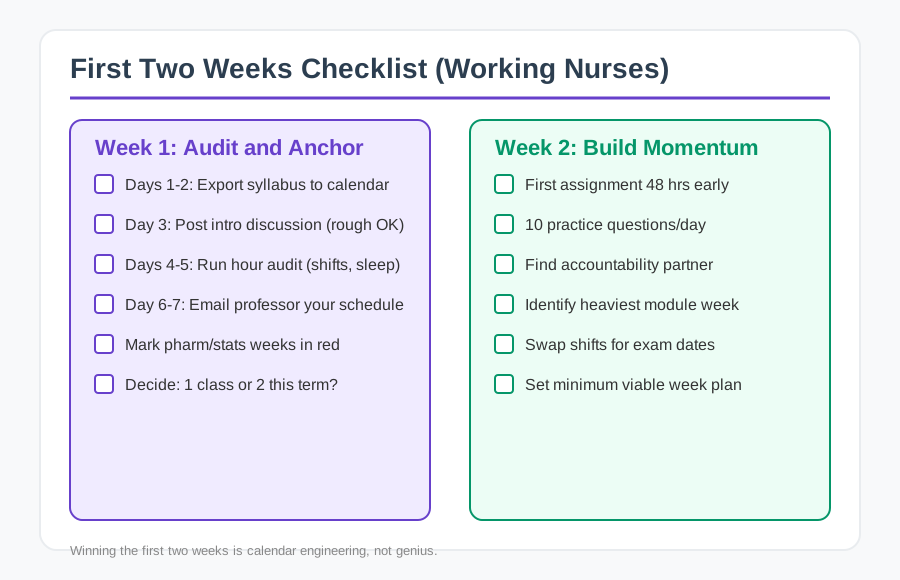
Day 1 to 2: Print or export the full syllabus. Put every deadline in one Google Calendar. Include discussion post days, not just major papers.
Day 3: Post your introduction discussion. Rough is fine. Posted beats perfect.
Day 4 to 5: Run your hour audit (shifts, sleep, family). Decide if this course load is actually sustainable.
Day 6 to 7: Email your professor with your work schedule and ask about the heaviest weeks in the term. Tara Horsley, RN, MSN, an online nursing instructor at UL Lafayette (.edu), tells students to set up a phone or virtual meeting when anxiety spikes. Use that offer.
Week 2: Build Momentum
Complete the first graded assignment at least 48 hours before the deadline. Start 10 practice questions per day if the course feeds into NCLEX-style exams. Identify one classmate or coworker in the same program for accountability texts.
College Transitions' 2025 RN-to-BSN guide notes the biggest challenge is not academic difficulty but protecting study time amid rotating schedules. Winning the first two weeks is mostly calendar engineering, not genius.
Common Mistakes Working Nurses Make in Online Classes
These are not character flaws. They are predictable patterns I see every term.
Mistake 1: Treating school like a hobby. BetterNurse.org says nurses who finish treat coursework like a second job with protected blocks. Nurses who withdraw treat it like something they will do when energy appears. Energy does not appear after night shift.
Mistake 2: Studying right after a 12-hour shift. College Transitions warns post-night-shift study is rarely productive. Your prefrontal cortex is done. Light review only. Save new content for days off.
Mistake 3: Staying one week behind the syllabus. Last week's incomplete work fights this week's deadlines. Anxiety eats the focus you needed for both. Read one week ahead when work is calm so brutal stretches do not snowball.
Mistake 4: Never emailing the professor. Online isolation makes nurses sit with confusion a five-minute email would fix. UL Lafayette faculty note online MSN graduates understand that fear. Ask anyway.
The thread connecting these mistakes? Assuming willpower will replace structure. It will not on a med-surg floor with mandatory overtime.
Essential Resources for Online Nursing Students
Free academic tools:
- OpenStax Nursing for supplemental reading
- Purdue OWL APA Guide (.edu) for paper formatting
- NCSBN for licensure and education data
- American Association of Colleges of Nursing for program context
Study and career data:
- BLS Registered Nurses Occupational Outlook (.gov): 5% employment growth projected 2024 to 2034, about 189,100 openings per year
- BetterNurse.org working nurse guide for hour audits and minimum viable weeks
Professional support from Best Class Helper: If you are a working RN who needs targeted help with discussions, care plans, or full online nursing class support, our team works with Canvas, ATI, and RN-to-BSN programs daily. Use help strategically, not as a substitute for learning what you need for the NCLEX.
Passing Your Online Nursing Class Is a Scheduling Problem First
Remember that 46% burnout figure from the opening? It is not destiny. It is what happens when protected study hours, course load, and floor demands never get honest math.
- Audit real weekly hours before you register for two classes
- Default to one course per term if you work 36+ hours on rotating shifts
- Front-load care plans, pharm weeks, and statistics modules
- Never work the night before a timed exam if you can avoid it
- Ask for help after the first bad exam, not after withdrawal deadlines pass
The BLS projects registered nurse employment to grow 5% from 2024 to 2034. Finishing your BSN or prerequisite class while employed keeps you in that pipeline. The degree matters for Magnet hospitals, leadership tracks, and NP programs down the road.
Your next step tonight: open your syllabus, put every deadline in one calendar, and count how many study hours you actually have next week. If the number scares you, that is useful information. Adjust now, not at midterms.
Struggling With Your Online Nursing Class?
Our U.S.-based RN and BSN specialists handle weekly discussions, NANDA care plans, and full Canvas courses while you focus on floor shifts. Get a realistic plan before midterms.
You started this article wondering if you could pass an online nursing class while working full-time. You can, with the right load and a shift-aware plan. If the math still does not work, talk to our team about nursing class support before grades slip.
Frequently Asked Questions
1. Can you pass an online nursing class while working full-time?
Yes, if your protected study hours match what the course demands. Most working nurses realistically have 8 to 15 hours per week for school after shifts and family time. One three-credit online nursing class usually needs 7 to 12 hours weekly. If you work 36+ hours on rotating shifts, start with one class per term. A 2019 study found 62% of online RN-BSN students worked full-time, so you are not an edge case. See our study hour audit before you register for two classes.
2. How many hours a week should I study for one online nursing class?
Plan on 7 to 12 hours per week for a single three-credit online nursing course while working full-time. The federal 3-to-1 rule puts a three-credit class near 9 hours minimum. Add 2 to 3 hours for APA papers and discussion replies. BetterNurse.org notes full loads expect 15 to 20 hours, which is why many floor nurses take one class at a time.
3. Should I work the night before a nursing school exam?
No, if you can avoid it. Post-shift fatigue tanks focus on dosage calc and pharmacology exams. A Galen College nursing student said she would fail exams after night shifts because she misread questions or could not focus. Swap shifts, use PTO, or schedule proctored exams on your first day off after a stretch. Light review only after a 12-hour shift.
4. What assignments take the most time in online nursing classes?
Care plans, weekly discussion boards, pharmacology modules, and nursing research papers eat the most hours for working students. Budget 4 to 6 hours per care plan early in the term. Discussion posts need an initial reply plus two peer responses on separate days. Pharm and statistics weeks can spike to 6 to 10 hours. Front-load those deadlines in your calendar the day the syllabus drops.
5. Can I get help with nursing discussion posts and care plans?
Yes. Targeted help works when you understand the material but cannot find 6 hours during a heavy clinical week. Our team supports discussion posts, care plans, and full online nursing classes on Canvas and ATI. Use help for time crunches, not as a substitute for NCLEX prep content you need on the floor.
6. How do I know nursing class help is original?
Ask for a plagiarism report and confirm work is written for your rubric, not recycled from a template bank. Legitimate services build assignments from your syllabus requirements, cite nursing sources correctly, and match your program's APA format. Avoid sites that promise instant downloads. Original work should pass Turnitin or your school's checker when submitted on your timeline.
7. What if I need revisions on a nursing assignment?
Request revisions before the deadline, with the professor's feedback or rubric attached. Most nursing papers need one round of edits for diagnosis wording, citation fixes, or discussion reply tone. Send the rubric section you missed and the grade you need. Revisions are faster when you flag issues within 24 to 48 hours of delivery, not an hour before Canvas closes.